

Actual contact
Identify the protected object and the rubbing surface, including edges and debris.
Industrial Abrasion Protection
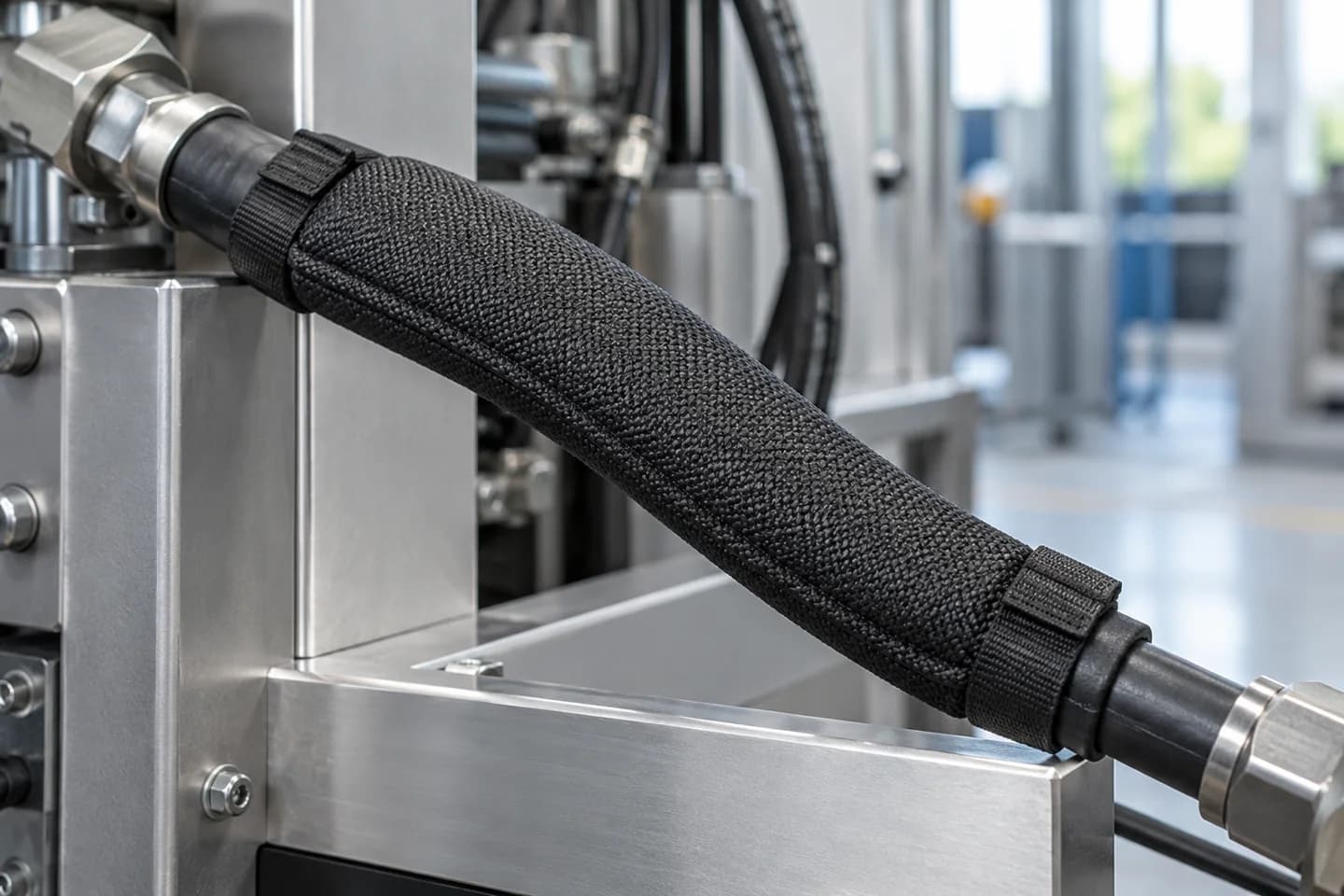
Protective textile structures developed around actual operating conditions such as movement, contact pressure, bending radius and repeated abrasion.
Application Overview
Protection performance is system-specific. A sleeve that performs well on a smooth hose may behave very differently against a sharp edge or under repeated bending.
01 / Application Challenge
A fabric abrasion count alone does not describe industrial protection. Contact surface, pressure, bending, sliding, temperature and repeated motion determine the relevant trial.
Identify the protected object and the rubbing surface, including edges and debris.
Define bending radius, stroke, speed, frequency and contact pressure.
Include temperature, fixing method and, where relevant, contamination or particles.
02 / Textile Solution Direction
Develop composite yarns, thick woven protection fabrics, tubular textiles or replaceable covers as a system with the underlying object. Evaluate both sleeve wear and the condition of what it protects.
Select thickness and structure for the actual contact conditions.
Inspect the cover and protected hose, cable or rope after representative cycles.
Plan fixing, inspection and replacement as part of the structure.
03
Woven panels developed for defined contact and fixing conditions.
Sized around the object and required bending range.
Wrapping directions for installation and maintenance access.
Covers designed around inspection and replacement.
Combine material and fabric roles for the operating brief.
04
Contact zones, bending and fixing on the actual hose.
Sleeves or wraps for repeated contact and movement.
External covers evaluated with the underlying rope.
Textile covers around defined equipment contact conditions.
Replaceable textile layers at repeated rubbing interfaces.
Protection developed with access and service needs in mind.
05
Evaluation is specific to the chosen construction, finishing and use conditions. A development direction does not establish finished-product performance or a certified protection level.
Review wear using the actual rubbing surfaces and pressure.
Check attachment under representative motion.
Observe movement of the sleeve relative to the protected object.
Review repeated bending at the intended radius.
Inspect the hose, cable or rope as well as the textile cover.
Review inspection access, removal and replacement.
Share these details with a component photo or current sleeve to define a representative trial.
06 / Material & Solution Scope
Select structures around the textile and application target; confirm the configuration through sample development.
A composite route for defined industrial protection development.
Select around contact, load and service conditions.
For selected flexible applications with evaluated motion and fit.
07 / Development Path
Define the current fabric, use context, failure point and evaluation target.
Select core, covering and reinforcement roles around the processing route.
Prepare sample yarn against the agreed development brief.
Coordinate knitting or weaving with long-term partner mills.
Compare actual fabric and representative components with the baseline; review adjustments and acceptance criteria.
After sample approval, Zhengnan coordinates quotation, order handling and project-based supply.
Yarn-to-Fabric
Zhengnan develops and manufactures the custom yarn, then can coordinate fabric trials with long-term partner mills. Customer communication, quotation, order handling and fabric supply remain with Zhengnan.
Share your current fabric, construction, target weight, application and the problem you want to improve. We can evaluate suitable yarn and textile development directions.
Discuss Your Application